From Classroom to Industry
Educational institutions must bridge the widening gap between traditional academic curricula and the complex demands of Industry 4.0 — and experiential learning technology is the critical missing link.
The Challenge: Rapid technological acceleration driven by Industry 4.0 has rendered traditional rote-learning and physical laboratory infrastructure insufficient, creating a critical skills gap where youth lack the technical and adaptive proficiencies demanded by modern employers.
The Solution: By adopting scalable, device-agnostic experiential learning technologies and virtual laboratories aligned with the National Education Policy (NEP) 2020, educational institutions can deliver high-fidelity, simulation-based training that builds essential technological competencies.
1. The Industry 4.0 Reality
The global industrial landscape is undergoing a profound metamorphosis. It is shifting from mechanized assembly lines to interconnected cyber-physical systems characterized by artificial intelligence (AI), the Internet of Things (IoT), cloud computing, and advanced robotics. This paradigm, known as Industry 4.0, is an operational reality demanding immediate alignment from the educational sector.
The acceleration of this digital transformation is reflected in global enterprise investments. Digital technologies are estimated to comprise 40% of all manufacturing technology expenditures by 2025.[1] A massive capital expenditure infusion of nearly $100 billion by key global players—including India—is currently paving the way for accelerated adoption of smart manufacturing protocols.[1]
In the context of India, the stakes are exceptionally high. The nation has set an economic mandate to increase the manufacturing sector’s contribution to the Gross Domestic Product (GDP) to 25% by 2025.[2] Achieving this objective requires a workforce capable of managing emerging network technologies, big data analytics, and remote-controlled monitoring systems. According to the World Economic Forum’s Future of Jobs 2023 report, 44% of workers’ core skills will be disrupted by 2027, with AI, big data, and analytical thinking ranking as top corporate training priorities.[3] The burden of supplying this talent falls directly on educational institutions, which must realign their pedagogical frameworks to reflect the realities of the modern digital enterprise.
2. The Skills Gap
Despite India’s demographic advantages, a severe disconnect exists between the competencies Indian graduates possess and the complex skills required by Industry 4.0 employers. This gap is a fundamental misalignment of cognitive and adaptive capabilities.
While national employability has shown incremental improvement, reaching 54.81% in recent assessments, nearly half of the graduate workforce remains unemployable in the modern digital economy.[4] A closer look at domain-specific employability reveals significant disparities driven by technological shifts. Computer Science and Information Technology graduates exhibit higher employability rates of 80% and 78%, respectively.[5] Conversely, foundational disciplines like Mechanical Engineering lag at 63%.[5] This discrepancy occurs because mechanical roles in Industry 4.0 require advanced digital integration—such as mechatronics and sensor data analysis—skills that traditional curricula often fail to provide.
The deficit in advanced technological talent is particularly acute in Artificial Intelligence. Despite leading in AI skill penetration, India’s AI talent pool is expected to grow to 1.25 million by 2027, yet demand is projected to exceed 2.3 million job openings — leaving a shortfall of over one million skilled professionals.[4] Employers increasingly require “composite capabilities”—a synthesis of technical acumen, domain knowledge, and professional soft skills like critical thinking.[6] The traditional education system struggles to foster these capabilities, resulting in graduates who possess theoretical degrees but lack the experiential fluency required to troubleshoot and innovate within AI-driven environments.
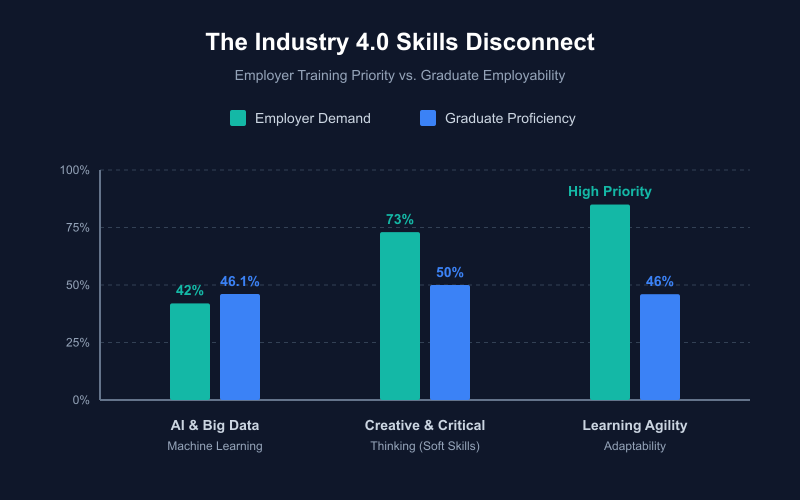 Figure 1: The Industry 4.0 Skills Gap — What employers demand versus what Indian graduates currently offer
3. Why Traditional Education Infrastructure Cannot Bridge This Gap?
The persistence of the skills gap can be traced directly to the structural limitations of traditional educational infrastructure. For decades, practical technical education has relied exclusively on physical laboratories. However, in the context of Industry 4.0, these physical spaces are increasingly proving inadequate and economically prohibitive.
The financial burden of establishing and upgrading physical laboratories is staggering. Advanced sensor arrays, precision manufacturing tools, and high-performance components require massive capital expenditures. Consequently, physical labs are often equipped with outdated machinery that bears little resemblance to the sophisticated environments graduates will encounter. Furthermore, physical infrastructure is constrained by geography and scheduling. High student-to-apparatus ratios severely limit individual hands-on time, relegating students to observing demonstrations rather than actively engaging with the equipment.
Beyond costs, physical laboratories inherently limit the scope of experimentation. Students are bound by the physical constraints of time and materials, making the process of trial-and-error punitive. The fear of breaking expensive equipment stifles curiosity, pushing students toward rigid execution of pre-defined lab manuals. Additionally, Industry 4.0 relies heavily on digital twins and cyber-physical systems. A traditional physical lab with isolated, analog equipment cannot simulate a decentralized, IoT-enabled factory floor, directly contributing to the lack of composite capabilities identified by industry leaders.
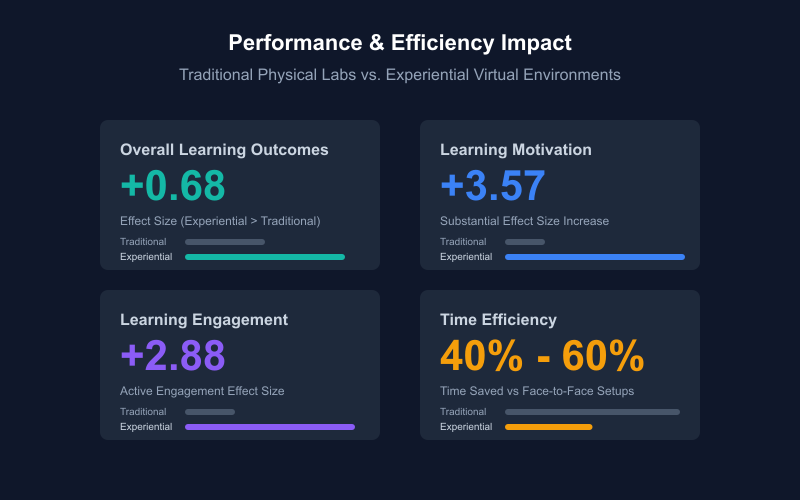 Figure 2: Traditional physical labs versus experiential learning platforms — a four-metric comparison
4. Competency based Experiential Learning as the Solution
To bridge the chasm between classroom theory and industrial application, pedagogy must evolve to embrace experiential learning. Experiential learning, particularly when mediated by immersive digital environments, shifts the educational focus from passive knowledge absorption to active discovery.
Empirical research underscores the effectiveness of simulation-based laboratories. A comprehensive meta-analysis of engineering education outcomes revealed that virtual laboratories serve as a highly significant predictor of student success, yielding a substantial improvement in cognitive and operational abilities compared to traditional methods.[8] Furthermore, virtual laboratories drastically improve psychological metrics crucial to adult learning, such as learning motivation and engagement.[8] By allowing students to visualize abstract concepts, virtual labs demystify complex phenomena. Because virtual environments allow for infinite repeatability without material cost, students are empowered to make mistakes, iterate, and deeply understand the consequences of variable manipulation.[9]
This transition toward digital experiential learning is a definitive policy mandate in India. The National Education Policy (NEP) 2020 explicitly demands an evolution in pedagogical methodologies to make education more experiential, inquiry-driven, and learner-centered.[10] Recognizing the limitations of physical infrastructure, NEP 2020 mandates that existing e-learning platforms be utilized to create virtual labs, ensuring that all students have equitable access to high-quality, hands-on, experiment-based learning.[10]
5. STEAMIFIED’s Role
To actualize the mandates of NEP 2020 and meet the requirements of Industry 4.0, educational institutions require sophisticated technological partners. STEAMIFIED addresses this institutional need by democratizing access to high-fidelity experiential infrastructure through cloud-based virtual laboratories. By eliminating the reliance on prohibitive physical hardware, the platform delivers immersive, device-agnostic simulations that translate theoretical concepts into applied competencies.
Central to this technological intervention is the, STEAMIFIED FRAMEWORK of Design, Education and Play: a pedagogical architecture that guides students through simulated environments in distinct, cumulative stages:
Observation: Students develop situational awareness and technological literacy by immersing themselves in accurate digital twins. This stage reduces cognitive load, allowing students to safely explore interfaces and visualize unobservable data flows, building foundational digital fluency.
Experimentation: Moving beyond passive observation, students manipulate variables and execute complex procedures within high-fidelity simulations. The fear of breaking equipment is eliminated, fostering an environment of rigorous trial and error where critical thinking and resilience are forged.
Mastery: Students consolidate their skills by solving unscripted, complex challenges that mimic real-world Industry 4.0 scenarios—such as optimizing a virtual supply chain algorithm. Progress is tracked through data-rich analytics, ensuring skills are directly aligned with employer demands.
 Figure 3: The STEAMIFIED FRAMEWORK of Design, Education and Play — from observation to mastery in simulated industry environments
6. The Institutional Imperative
The integration of experiential virtual laboratories is no longer an optional upgrade; it is an imperative for educational institutions in India. The convergence of national policy shifts and the unforgiving demands of the global labor market has created an environment where adaptation is necessary for institutional relevance.
As the job market evolves, prospective students and employers are evaluating institutions based heavily on their placement records and alignment with future-ready skills. If an institution’s graduates consistently fall into the unemployable demographic due to outdated training, enrollment and reputation will inevitably decline.
Administrators face a distinct choice. Maintaining reliance on expensive, static physical infrastructure and rote memorization will result in depreciating institutional value. Conversely, strategically partnering with platforms that deliver scalable, cloud-based experiential learning will immediately modernize the curriculum, drastically reduce infrastructure costs, and supply the global economy with the highly capable workforce it requires. The tools to execute this transformation are available; the responsibility now lies with institutional leadership to implement them.
References
NASSCOM. (2025). India Industry 4.0 Adoption: A Case to Mature Manufacturing Digitalization by 2025. https://community.nasscom.in/index.php/communities/industry-40/india-industry-40-adoption-case-mature-manufacturing-digitalization-2025
World Economic Forum. (2023). The Future of Jobs Report 2023. https://www.weforum.org/publications/the-future-of-jobs-report-2023/
ForumIAS. (2025). India as Global Skill Capital: Significance and Challenges. https://forumias.com/blog/india-as-global-skill-capital-significance-and-challenges-explained-pointwise/
The Times of India. (2025). Are engineering graduates back in demand? Computer Science and IT drive B.Tech employability surge in India. https://timesofindia.indiatimes.com/education/careers/news/are-engineering-graduates-back-in-demand-computer-science-and-it-drive-b-tech-employability-surge-in-india/articleshow/127798524.cms
Li J., Liang W. (2024). Effectiveness of virtual laboratory in engineering education: A meta-analysis. PLOS ONE. https://journals.plos.org/plosone/article?id=10.1371/journal.pone.0316269
Ministry of Human Resource Development, Government of India. (2020). National Education Policy 2020. https://www.education.gov.in/sites/upload_files/mhrd/files/NEP_Final_English_0.pdf
Mercer | Mettl. (2025). India Graduate Skill Index 2025. https://www.mercer.com/insights/talent-and-transformation/talent-assessment/indias-graduate-skill-index-2025/
Evolmind. (2025). E-learning or traditional training: which is best for your company? https://www.evolmind.com/en/blog/e-learning-or-traditional-training-which-is-best-for-your-company/
Disclaimer
Regarding educational frameworks and statistics:
The frameworks, pedagogical concepts, and proprietary methodologies discussed herein, including the, are the intellectual property of the publisher and are provided for informational and illustrative purposes. All statistics, market projections, and employability data cited in this report have been sourced from publicly available industry reports as of the time of writing. The publisher makes no representations regarding guaranteed institutional outcomes or student employability, as these depend on a multitude of independent factors.
Regarding third-party websites:
This document references external organizations, third-party frameworks, government policies, and industry indices. These external links are provided strictly for informational purposes. The inclusion of such information does not imply an endorsement, partnership, or official affiliation between the publisher and these third-party entities.
General provisions:
This content is provided on an “as is” basis without any warranties, either express or implied, including but not limited to warranties of accuracy, completeness, or fitness for a particular purpose. Readers and institutional decision-makers must consume and apply this information at their own risk.