Sustainable Education Through Immersive Learning
Executive Summary
The Challenge: Traditional education relies heavily on expensive, physical buildings. This outdated model limits who gets to learn and relies on passive memorization, leaving young people totally unprepared for the modern workforce.
The Solution: Immersive learning platforms and virtual labs break down the physical barriers to learning new skills. By using Extended Reality (XR) and game-like teaching methods, these highly scalable systems help students worldwide learn practical skills much faster.
1. The Problem with Traditional Learning Systems
Today’s global education system is built on an old model. It assumes students must be in a physical classroom, using local materials and traditional teaching methods. While this worked well in the 20th century, it is now struggling to keep up with a growing global population and chronic underfunding.
Relying on physical infrastructure to teach STEAM (Science, Technology, Engineering, Arts, and Mathematics) creates a massive roadblock. “Arts” has increasingly gained traction, transforming the traditional STEM framework into STEAM by adding creative problem-solving to the mix. However, the sheer cost of building and running physical STEAM labs makes equal education almost impossible. According to UNESCO, one in three schools worldwide still lacks basic drinking water and sanitation.[1] Expecting every school to build a state-of-the-art physical lab when many can’t even provide clean water is simply unrealistic.
This physical limit is obvious when we look at India compared to global data. According to India’s UDISE+ 2022-23 report, only 57.1% of secondary schools have integrated science labs on average.[2] While this shows progress, it also means nearly half of India’s secondary students are learning science strictly from textbooks, without any hands-on practice.
Even when physical labs do exist, they are tied down by strict safety rules and the high cost of materials. This stops students from doing trial-and-error experiments, the true heart of science, and traps them in a cycle where they just watch instead of actually doing.
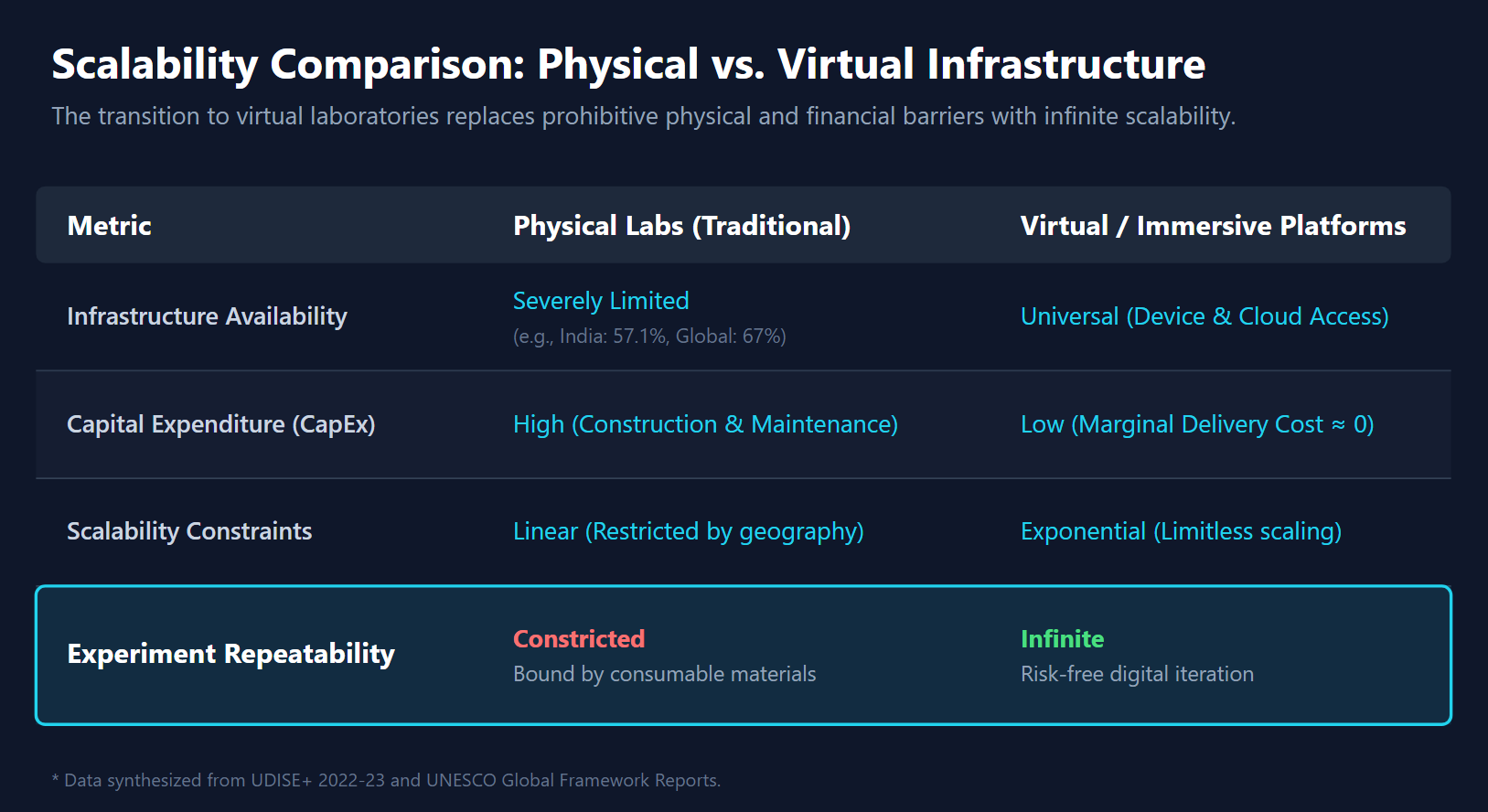
The transition to virtual laboratories replaces prohibitive physical and financial barriers with infinite scalability.
2. Virtual Labs as a Sustainable Solution
If we want to educate billions of students effectively, we have to rethink what sustainability really means. A truly sustainable system uses resources wisely, gives everyone a fair chance regardless of their background, and keeps teaching quality high everywhere. Virtual labs are the most realistic way to make this happen.
By moving from physical buildings to cloud-based platforms, schools can stop worrying about constantly rising running costs, like buying expensive chemicals or fixing broken equipment. Instead, they shift to a model that easily grows with them. Once a high-quality virtual simulation is created, it costs almost nothing to share it with one more student.
Virtual labs also save a massive amount of time. Teachers using advanced simulations report that complex biochemistry labs, which usually take days because of wait times, can be finished online in just 30 minutes.[3] This saved time lets classes cover topics that are usually too dangerous, too slow, or too fast to observe safely in a real classroom. By freeing education from physical locations, virtual platforms give any student with an internet connection access to top-tier experiments.
3. Immersive Learning and Better Outcomes
For education to be truly sustainable, the tools we use must actually help students learn better. Adding Extended Reality (XR), which includes Virtual Reality (VR) and Augmented Reality (AR), along with game-like designs, completely transforms how well students understand and remember things.
Extended reality skips the heavy reading and complex diagrams by making students feel like they are actually in the room doing the experiment. This drastically cuts down the mental strain of trying to picture tough concepts from a flat textbook page.[4] A major review of virtual labs in engineering showed they have a massive positive impact on educational outcomes, scoring a high overall effect size of +0.686.[5]
The biggest leaps happen in student motivation. That same study found that virtual labs boost “learning motivation” by an incredible +3.571.[5] When learning feels real, independent, and gives instant feedback, it triggers the brain’s natural reward system.
The corporate world backs this up strongly. A comprehensive study by PwC found that employees trained with VR learned up to four times faster than those in traditional classrooms. Plus, the VR learners were 275% more confident in applying what they learned, a huge 40% jump over normal classroom training.[6]
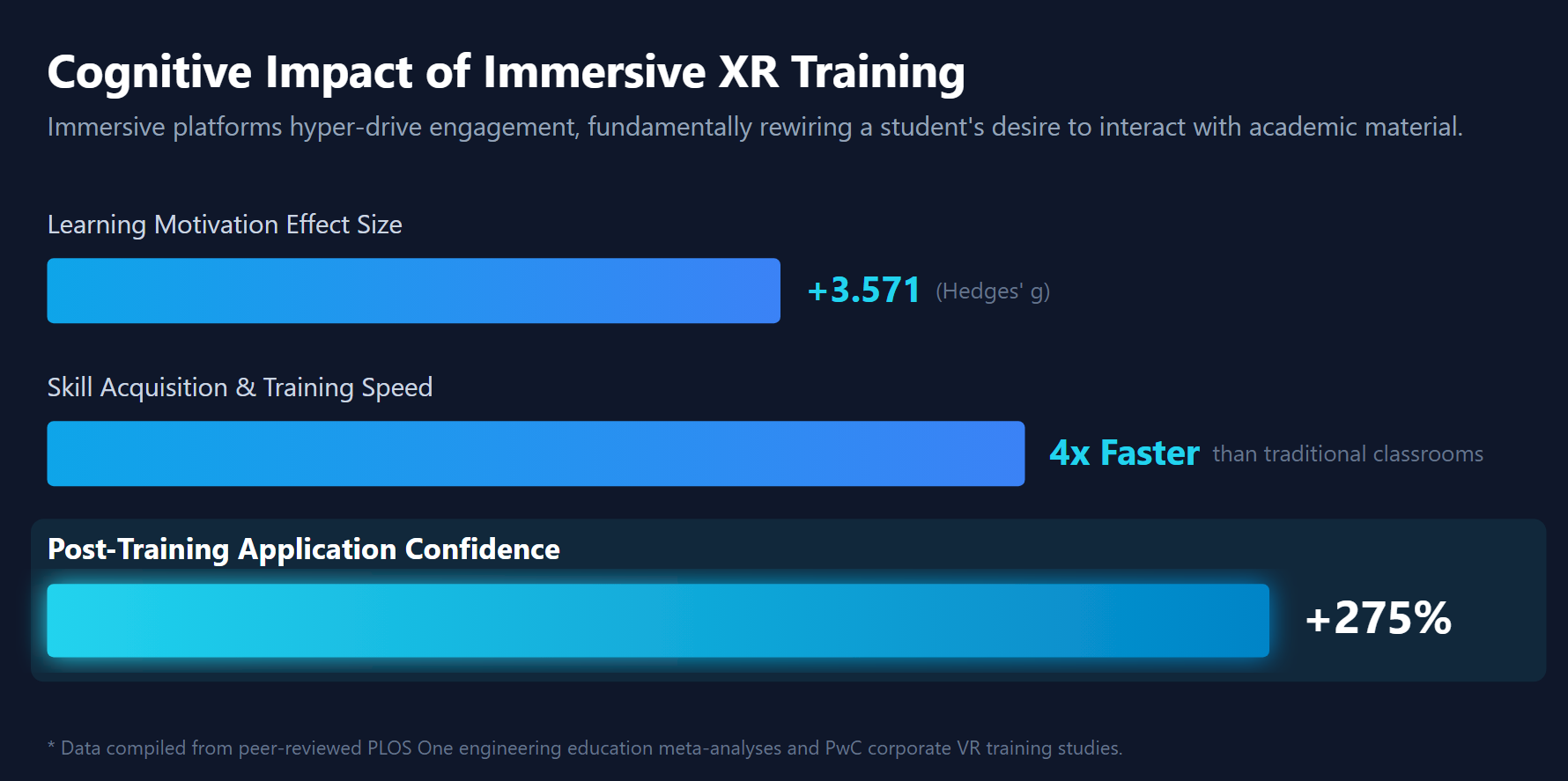
Immersive XR platforms hyper-drive engagement, fundamentally rewiring a student’s innate desire to interact with complex academic material.
4. Bridging the Theory-Practice Gap
The main goal of any education system is to get people ready for the real-world job market. However, global data shows a huge gap between what schools teach and what employers actually need.
The job market is changing fast. According to the International Labour Organization’s (ILO) Global Employment Trends for Youth 2024 report, 2 in 3 young workers in developing countries hold degrees that don’t match their current jobs. Even with global youth unemployment at a low 13%, there is a severe mismatch between academic credentials and practical abilities. Traditional schooling focuses too much on memorizing facts (the “what”) and fails to teach practical skills (the “how” and “why”).
Immersive platforms fix this gap directly. By safely copying real-world situations, AR/VR games force learners to deal with complex variables and get instant feedback. Whether a student is fixing a virtual power grid or practicing safety steps, they stop just remembering and start actively solving problems. This safe space lets them fail and try again as many times as they need. It cuts down the learning curve and makes them ready for the workforce from day one.
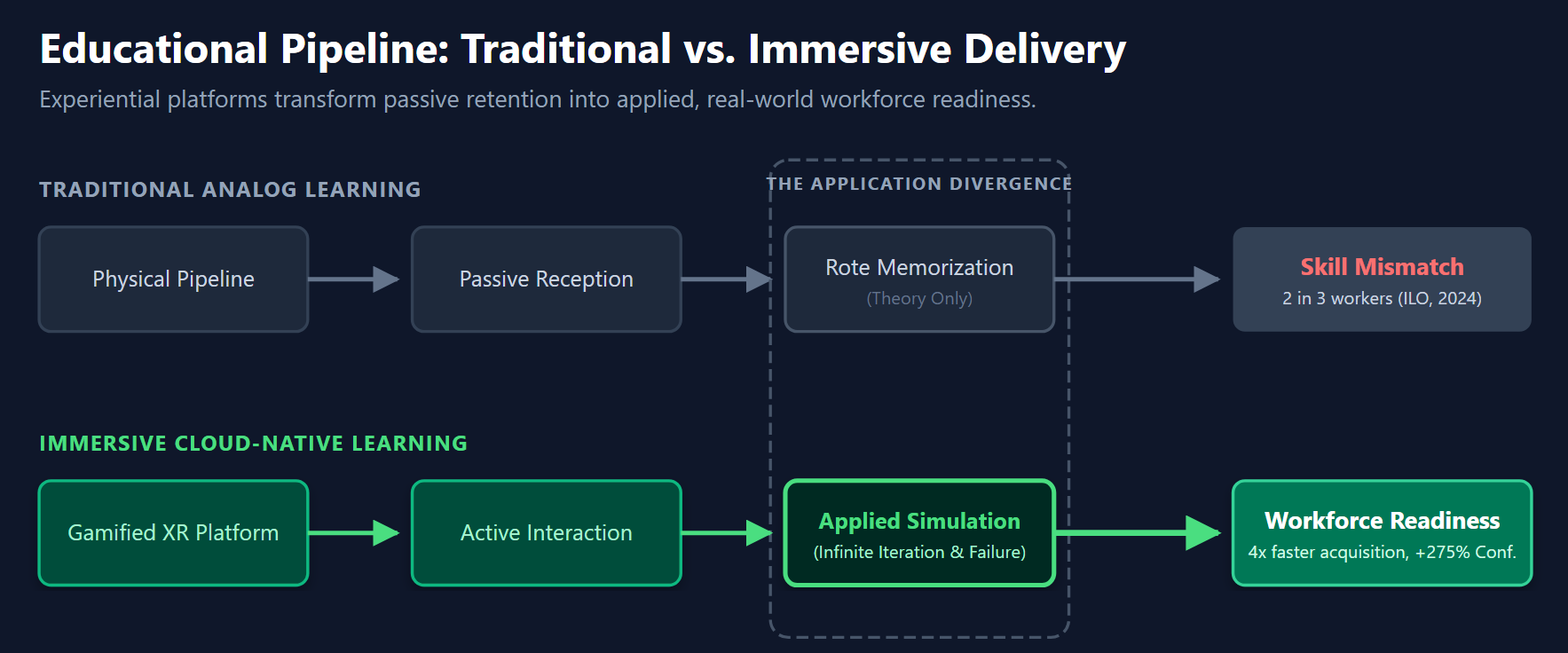
Experiential platforms actively rewire the educational pipeline, transforming passive retention into applied, real-world workforce readiness.
5. The Role of Platforms like Steamified
We know traditional schools face physical limits, and we know immersive XR helps students learn better. The next challenge is figuring out how to roll this out on a massive scale. To be truly sustainable, we need a complete system that blends advanced tech with strong teaching methods.
This is exactly where platforms like Steamified step in. Built to replace the physical and financial roadblocks of older models, Steamified mixes the creative freedom of an interactive playground with the strict teaching standards of curriculum-aligned XR (AR/VR) technology.[7]
In the past, XR in education was held back because VR headsets were simply too expensive. Steamified bypasses this problem completely by running from the cloud. By processing complex 3D simulations online, Steamified ensures that high-quality experiences work perfectly on all devices: from cheap smartphones in rural villages to high-end VR headsets in city universities.[7] Because the platform works on almost any device, it creates true, equal access for everyone.
For schools, Steamified is a smart financial move. By offering digital versions of expensive, professional equipment, partner schools save up to 40% on maintaining physical labs and replacing broken gear.[7] Best of all, because students can repeat complex experiments online without any extra cost or risk, they remember up to 60% more than their peers in traditional classrooms, a luxury that is impossible in the physical world.[7]
6. The Future of Sustainable Education
The future of global education is deeply tied to immersive platforms. Thanks to their ability to scale endlessly, the Virtual Reality in Education market is expected to skyrocket to $95.28 billion by 2031, growing by 20.4% every year.[8]
At the same time, governments everywhere are realizing that falling behind in digital education means falling behind economically. As the global youth population grows, it is mathematically impossible to build enough physical schools and brick-and-mortar labs to keep up with the demand.
Adding artificial intelligence and spatial computing into platforms like Steamified will make virtual learning even smoother and more natural. Sustainable education is no longer just a luxury for wealthy nations; it is an absolute necessity for global economic stability, fixing the massive gaps we see in both India and around the world.
Conclusion
We can no longer pretend that a good education requires expensive, exclusive physical buildings. Traditional labs cost too much, are stuck in one place, and limit how students learn in a world that desperately needs fast, hands-on problem solvers. True sustainability means moving to systems that separate the quality of learning from the limits of a physical room.
Immersive learning, powered by Extended Reality, game-like features, and cloud technology, is the ultimate way forward. By adopting platforms like Steamified, schools can break through their physical walls, stop wasting money on gear that breaks, and raise a highly skilled generation of critical thinkers ready for the modern job market. The future of education isn’t bound by brick and mortar; it is endlessly scalable, highly digital, and fully experiential.
Works cited
UNESCO: Educational achievement is hampered by lack of investment in health and nutrition, accessed March 25, 2026, https://www.unesco.org/en/articles/unesco-educational-achievement-hampered-lack-investment-health-and-nutrition
Telangana’s secondary schools with science labs higher than national average, but lags behind several States - The Hindu, accessed March 25, 2026, https://www.thehindu.com/news/national/telangana/telanganas-secondary-schools-with-science-labs-higher-than-national-average-but-lags-behind-several-states/article70650861.ece
Virtual Labs are Reducing the Cost of STEM Education - Labster, accessed March 25, 2026, https://www.labster.com/blog/cost-savings
The Promise of Immersive Learning: Augmented and Virtual Reality’s Potential in Education, accessed March 25, 2026, https://itif.org/publications/2021/08/30/promise-immersive-learning-augmented-and-virtual-reality-potential/
Effectiveness of virtual laboratory in engineering education: A meta …, accessed March 25, 2026, https://journals.plos.org/plosone/article?id=10.1371/journal.pone.0316269
How virtual reality is redefining soft skills training: PwC, accessed March 25, 2026, https://www.pwc.com/us/en/tech-effect/emerging-tech/virtual-reality-study.html
STEAMIFIED, accessed March 25, 2026, https://steamified.io/
Virtual Reality in Education Market Size & Share, 2031 - Mordor Intelligence, accessed March 25, 2026, https://www.mordorintelligence.com/industry-reports/virtual-reality-vr-market-in-education
Disclaimer
Regarding educational frameworks and statistics
The insights, data points, and educational frameworks in this report are synthesized from global organizational databases, including the World Bank, ILO, OECD, and UNESCO, and national reports like UDISE+. While every effort has been made to ensure the accuracy of the statistics regarding laboratory infrastructure, access gaps, and learning outcomes, these figures are subject to statistical variations and methodological updates by their issuing organizations. The authors and Steamified assume no liability for errors, omissions, or subsequent revisions to these datasets.
Regarding third-party websites
This document contains references and links to external third-party websites, market research, and academic journals. These links are provided solely for informational purposes to substantiate the perspectives discussed herein. Steamified does not endorse, control, or monitor the content or practices of these external sites. We make no warranties regarding the accuracy or completeness of information found on third-party websites, and accessing these links is entirely at the reader’s own risk.
General provisions
The strategic forecasts and opinions expressed in this blog represent the professional analysis of the authors and do not reflect the official policy of any referenced institution. This report is intended strictly for thought leadership and educational discussion. It should not be construed as formal legal, financial, or policy advice. Readers must independently verify all information and consult appropriate professional advisors before making any institutional decisions based on this publication.